Unlock Your 7-Day Free Trial with Free Credits!
Get Started for Free



How to Reduce Business Messaging Costs Across WhatsApp, RCS & SMS
October 16, 2026
.
11 min read
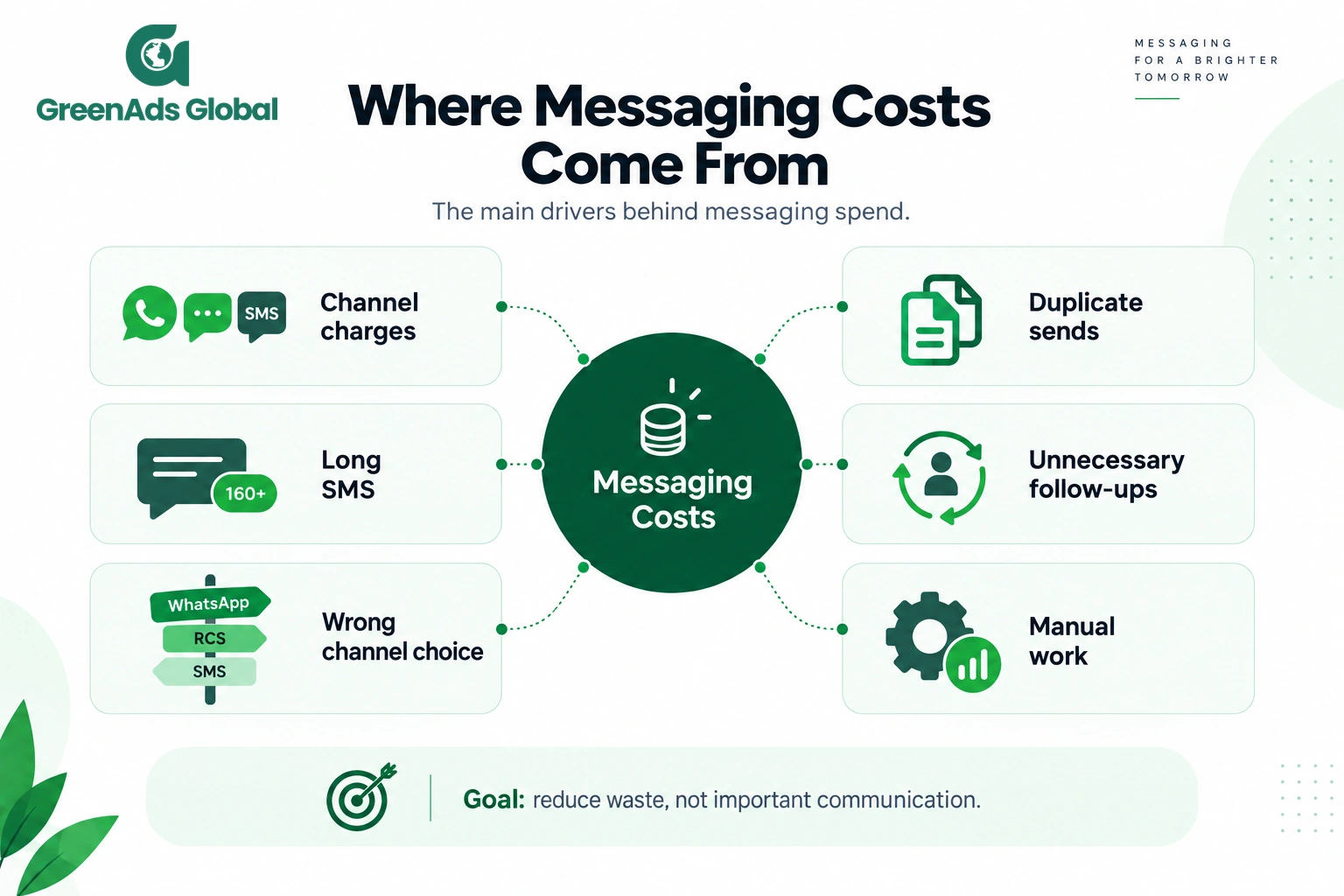
Table of contents

Businesses can reduce messaging costs by choosing the right channel for each customer and use case, avoiding duplicate or unnecessary sends, stopping follow-ups after the customer has completed the intended action, and using CRM or commerce data to keep communication relevant. Smarter segmentation, selective fallback between WhatsApp, RCS and SMS, concise message design, and outcome-based measurement help control spend without compromising important customer communication.

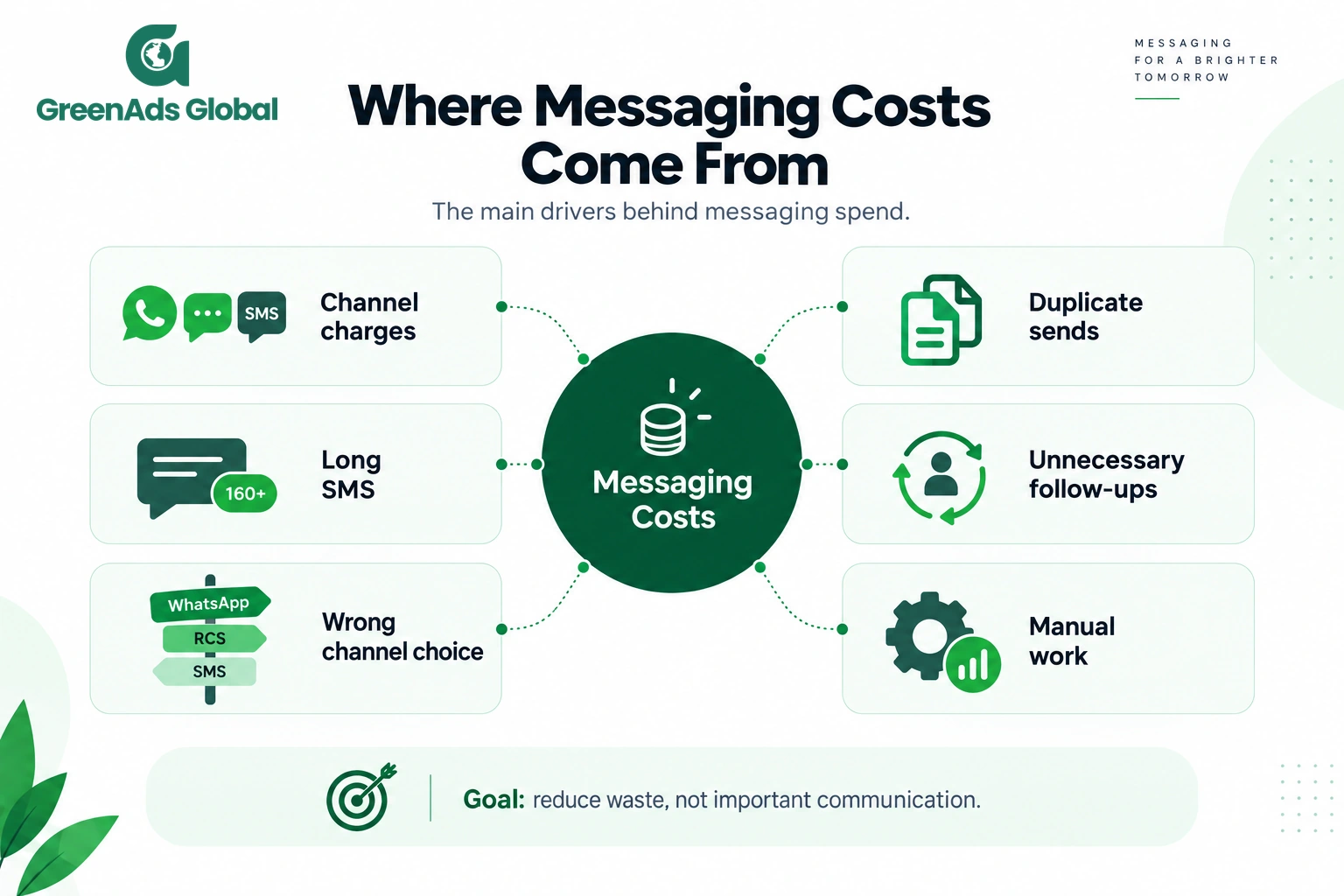
Business messaging costs rarely come from one price alone. They come from the combination of channel charges, unnecessary retries, duplicate outreach, poorly targeted campaigns, long message formats, and follow-ups that continue after the customer has already completed the intended action.
This guide explains how to reduce business messaging costs across WhatsApp, RCS and SMS without treating the cheapest channel as the only answer. The goal is to spend on communication that is useful, stop communication that is no longer needed, and measure cost against a real business outcome.
1. Where Do Business Messaging Costs Actually Come From?
Start by separating the costs you can see from the costs hidden inside a workflow.
Channel charges
WhatsApp, RCS and SMS use different pricing models, commercial terms and billing units. Rates can vary by destination, message type, carrier, volume and provider agreement, so use your own account pricing rather than assuming one universal rate.
Messages sent after the customer has converted
A customer who has already purchased, paid, booked or confirmed should normally exit the relevant reminder journey. Continuing to send can waste budget and create a poor experience.
Operational handling
Messaging cost is not only a channel invoice. Manual list preparation, repeated exports, agent follow-up and reconciliation between disconnected tools can add operational work around every campaign.
2. Why the Cheapest Message Is Not Always the Lowest-Cost Outcome
A channel with a lower unit cost may still be the wrong choice if it cannot carry the information or interaction the customer needs. Likewise, a richer channel may be unnecessary for a short alert.
Use the business outcome as the denominator. Compare cost per useful delivery, qualified enquiry, completed booking or successful transaction—not only cost per message sent.
For example, an order-delay alert may only need a concise update and a link. A product-discovery campaign may benefit from richer content and guided actions. The right channel depends on the job.
3. How Should You Choose the Right Channel Before Sending?
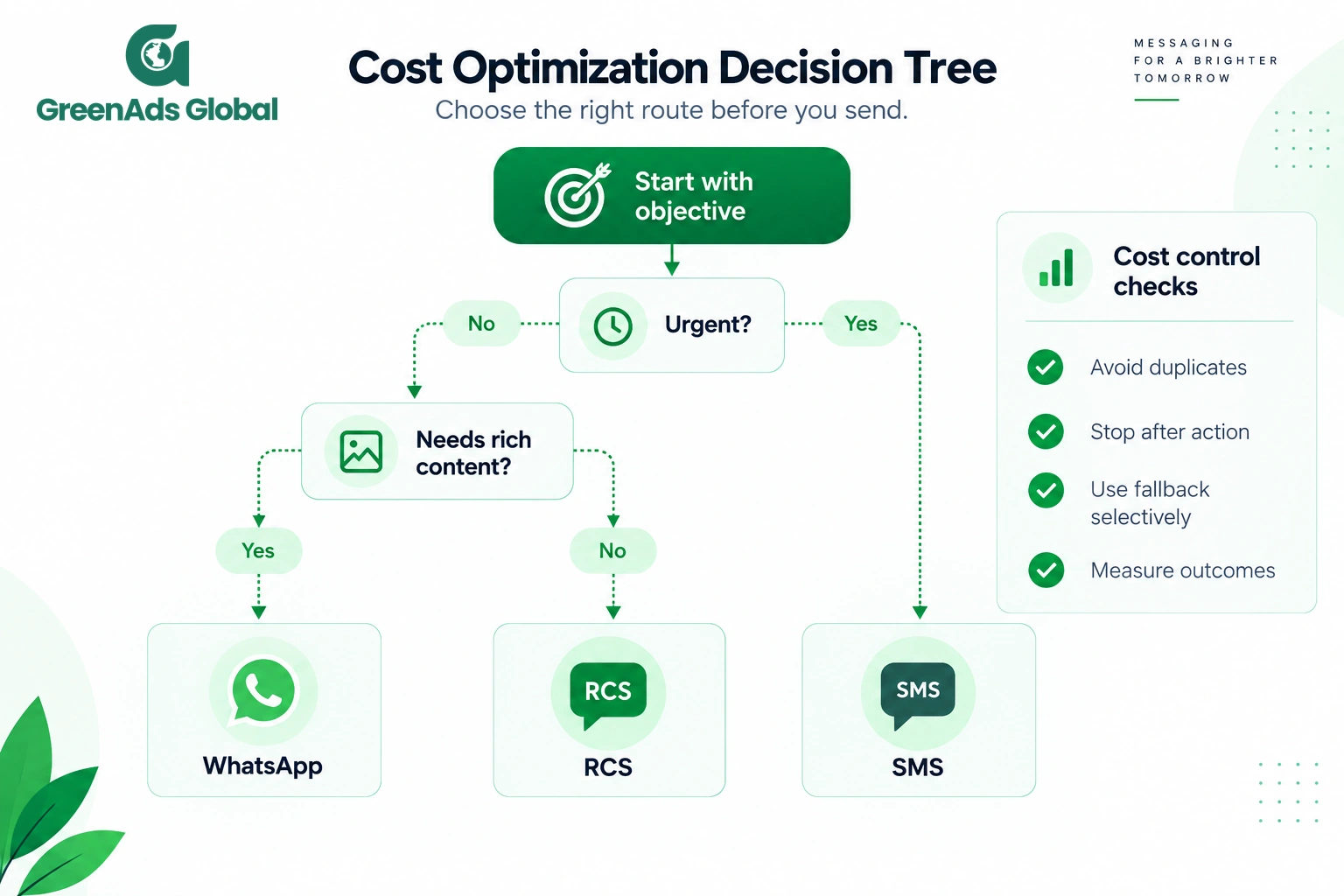
Use a simple decision framework before building the campaign.
- Purpose: Is this a service update, marketing campaign, reminder, authentication flow or sales conversation?
- Customer eligibility: Is the customer reachable and permitted to receive this message on the selected channel?
- Urgency: Does the message have a deadline after which it becomes useless?
- Content requirement: Do you need media, rich cards, interactive actions or only plain text?
- Reply requirement: Does the customer need to respond, choose an option or speak with a person?
- Cost and expected value: Is the richer experience justified for this audience and objective?
GreenAds Global's omni-channel messaging platform brings WhatsApp, RCS and SMS into one channel strategy. For channel-specific planning, review the WhatsApp Business API, RCS Business Messaging and business SMS service pages.
4. How Can Segmentation and Stopping Rules Reduce Unnecessary Sends?
One of the simplest cost controls is to avoid sending a message to someone who no longer needs it.
Segment by the event that matters
Build audiences around current customer state: new lead, cart abandoned, order confirmed, payment pending, appointment scheduled or renewal due. Broad lists are easier to create but often create more irrelevant sends.
Check the source of truth before each important follow-up
If the CRM, commerce platform or booking system says the customer has completed the action, suppress the next reminder.
Deduplicate contact records
Two records for the same person can create duplicated outreach, conflicting histories and unnecessary charges.
Use explicit exit conditions
Every automated journey should answer: When does this customer leave the workflow? Completion, opt-out, expiry and manual resolution are common exits.
5. Can Fallback Messaging Reduce Costs?
Fallback can help avoid blind dual-sending when it is used selectively. Instead of sending the same notification on two channels immediately, the business can use one preferred route first and send a backup only when the agreed delivery conditions justify it.
That does not mean fallback always reduces cost. A secondary SMS can still add another charge. The value comes from using the second route only when it protects an important customer update.
For a full workflow, see WhatsApp and RCS to SMS fallback messaging.
6. How can message design be created without hurting customer experience?
Message format affects both cost and performance.
Keep SMS concise
SMS is best used for focused information. Long or non-standard-character messages may be split into multiple segments depending on encoding and provider rules, so review the final personalized message—not only the template draft.
Use rich formats only when the interaction needs them
Google's RCS for Business guidance supports text, media, rich cards, carousels, suggested replies and suggested actions. Those formats are useful when they help the customer understand or act; they are unnecessary when a short notification is enough.
See Google's official RCS messaging guidance.
Keep WhatsApp message purpose and permission clear
WhatsApp Business messaging rules require businesses to use approved message templates where applicable and to respect user permissions and opt-outs. Sending unwanted or poorly targeted communication is not a cost-optimization strategy.
See the official WhatsApp Business messaging policy.
7. Why Does CRM and Commerce Data Matter for Messaging Cost Control?
A messaging platform can only make good decisions if the underlying customer state is current. Connecting messaging with CRM, commerce or booking data helps the business know whether a customer still needs the next message.
A practical workflow is:
- A customer action or CRM status starts the workflow.
- The system checks customer eligibility and the current record state.
- The appropriate message is sent.
- A reply, purchase, payment or status change updates the record.
- The next step is suppressed or changed when the goal is already complete.
For a WhatsApp-specific implementation example, see how to integrate CRM with WhatsApp. For a broader cross-channel model, see our guide to CRM-connected customer communication workflows.
8. What Should You Measure to Know Whether Messaging Is Cost-Efficient?
Do not evaluate a cost-control change from message volume alone.
- Total channel spend: actual billed spend across channels in scope.
- Cost per useful delivered notification: total relevant spend divided by unique notifications delivered while still useful.
- Cost per qualified enquiry: useful for lead-generation campaigns.
- Cost per completed booking or purchase: useful when attribution is reliable.
- Duplicate-message rate: customers who received unnecessary repeat copies.
- Suppression rate: messages correctly prevented because the customer had already completed the action.
- Fallback recovery: customers reached through an eligible secondary route after the primary route did not complete delivery.
Where possible, compare changes with a consistent baseline or controlled test. Do not treat every conversion after a message as proof that the message caused it.
9. How Can Telinfy Support a More Cost-Conscious Messaging Strategy?
Telinfy by GreenAds Global is an omnichannel messaging platform for WhatsApp Business API, RCS, SMS and Voice. Its platform capabilities include multichannel campaigns, fallback, integrations, messaging workflows and analytics.
That can support a cost-control process by giving teams one place to coordinate channel selection, customer journeys and reporting. The platform should not be treated as a promise of a fixed saving percentage: actual costs depend on your traffic, destination mix, message categories, commercial terms and workflow design.
Build a Messaging Cost Plan Around Real Customer Journeys
If your messaging budget is growing faster than customer outcomes, start with one high-volume workflow and map every message, retry and handoff. GreenAds Global can help you review the channel mix and identify where a coordinated Telinfy messaging workflow may fit.
See how CRM events become customer communication
Open each workflow to see the trigger, live-data check, communication action and stopping condition.
New lead qualification
Abandoned cart follow-up
Appointment communication
Payment or renewal reminder
Should the next message still be sent?
Open a customer state to see how current CRM or commerce data should change the workflow.
Lead is already qualified
Customer completed the purchase
Appointment was cancelled
Payment is complete
₹ 899
₹ 2,249
₹ 3,149
$30
$50
Frequently Asked Questions
How can a business reduce messaging costs without sending fewer important updates?
Start by removing unnecessary sends rather than important communication. Use better segmentation, current CRM or commerce data, clear journey exit rules, duplicate prevention and the right channel for each message. A multichannel messaging platform such as Telinfy can help coordinate those decisions across configured channels.
Is SMS always cheaper than WhatsApp or RCS?
No universal answer applies. Rates vary by destination, message type, volume and commercial agreement, and a lower unit price does not guarantee a lower cost per business outcome. Review current WhatsApp Business API pricing, RCS messaging pricing and your contracted SMS rates.
When should a business use RCS instead of SMS?
RCS can make sense when verified branding, media, rich cards or guided actions add value for an RCS-reachable customer. SMS is often more appropriate for concise alerts and backup communication. See the GreenAds Global guide to RCS Business Messaging.
Can fallback messaging reduce unnecessary spend?
It can reduce blind dual-sending when a business uses one preferred route first and sends a backup only after the agreed status and eligibility checks. It can also add cost if the second channel is triggered too aggressively. See the guide to WhatsApp and RCS to SMS fallback.
How can CRM data help reduce messaging waste?
CRM data can tell the messaging workflow when a lead has converted, a payment is complete, an appointment is cancelled or a case is resolved. Those state changes can stop or change future messages. See CRM and WhatsApp integration for a channel-specific example.
What metrics should marketing teams use to evaluate messaging cost?
Useful metrics include total channel spend, cost per useful delivered notification, cost per qualified enquiry or conversion where attribution is reliable, duplicate-message rate, suppression rate and fallback recovery. Avoid judging efficiency from cost per send alone.
How can a business reduce messaging costs without sending fewer important updates?
Start by removing unnecessary sends rather than important communication. Use better segmentation, current CRM or commerce data, clear journey exit rules, duplicate prevention and the right channel for each message. A omni-channel messaging platform such as Telinfy can help coordinate those decisions across configured channels.
How does customer segmentation help reduce messaging costs?
Segmentation helps prevent irrelevant messages from being sent to customers who are unlikely to need them. Build audiences around current customer state, behaviour, location, lifecycle stage or a specific business event, and suppress people who have already completed the intended action. Better targeting reduces unnecessary sends while keeping important communication intact.
Should a business send the same campaign on WhatsApp, RCS and SMS at the same time?
Usually not. Sending the same message on every channel can create duplicate communication and unnecessary cost. A better multichannel messaging strategy gives each channel a specific job and uses a second route only when the customer journey or delivery conditions justify it.
How can Telinfy help businesses control messaging costs?
Telinfy by GreenAds Global brings WhatsApp Business API, RCS, SMS and Voice into one omnichannel platform with campaigns, fallback, integrations and analytics. This can help teams coordinate channel selection, stopping rules and reporting from one workflow. Actual savings depend on message volumes, destinations, channel pricing and how the business configures its journeys, so Telinfy should not be treated as a guarantee of a fixed cost reduction.
You may Also like
Book a One-to-One Meeting With Our Product Expert
Have questions? We have got answers! Connect with our product expert for a personalized demo session and discover the best messaging solutions for your business.
.svg)
